₿ BITCOIN47.COM
Bitcoin Volatility: Hold Through the Dip
When Bitcoin drops 40–80%, most holders face the same test. The framework for understanding volatility, stacking sats, and holding through cycles.
"Bitcoin has died 473 times according to 99Bitcoins.com. It's still here. Price volatility is not a bug — it is the cost of permissionless, open, 24/7 access to the hardest money ever invented."

The $60K Test
Every holder eventually faces their version of the same moment: Bitcoin drops to a number that feels wrong. The headlines shift from "Bitcoin is changing finance" to "Is Bitcoin dead?" Social media fills with panic. Acquaintances who were curious six months ago are suddenly confident it's over.
This is not new. Bitcoin has experienced drawdowns of more than 80% from peak to trough multiple times in its history:
| Cycle | Peak | Trough | Drawdown |
|---|---|---|---|
| 2011 | ~$32 | ~$2 | −94% |
| 2013–2015 | ~$1,100 | ~$150 | −86% |
| 2017–2018 | ~$20,000 | ~$3,100 | −84% |
| 2021–2022 | ~$69,000 | ~$16,000 | −77% |
Every one of those troughs looked, in the moment, like the end. Every one was followed by a new all-time high.
We do not provide investment advice, price targets, or return guarantees. This page discusses historical patterns and philosophical frameworks used by long-term Bitcoin holders. All investment decisions are your own.
The question is not whether Bitcoin will face another down cycle. It will. The question is whether you understand what you hold well enough to hold it through one.
Why Bitcoin Is Volatile — and Why That's Expected
Bitcoin's volatility is a feature of what it is, not a flaw in what it should be.
It's open and permissionless. Any person on earth with internet access can buy or sell Bitcoin at 3am on a Sunday. Unlike stocks, which are gated behind market hours, regulated exchanges, and accredited-investor rules, Bitcoin trades 24/7 globally. This creates genuine price discovery — and genuine swings.
It has no earnings or dividends. Traditional assets are valued partly on cash flows: earnings, dividends, rents. Bitcoin produces no cash flow. Its value is a function of network adoption, scarcity belief, and monetary premium — all inherently harder to quantify, and therefore more sensitive to sentiment.
It has a fixed supply entering a growing demand market. When demand surges, price moves hard because supply cannot respond. When sentiment collapses, price moves hard the other way. This asymmetry between fixed supply and variable demand produces volatility that gradually narrows as the network matures and liquidity deepens — but it never fully disappears.
The volatility has been consistently directional over long timeframes. Despite the dramatic drawdowns above, someone who bought Bitcoin at any point more than four years ago is currently in profit. That doesn't guarantee the future. But it reflects the underlying dynamic: adoption has been growing faster than sentiment craters.
Staying Committed: The Conviction Framework
Holding Bitcoin through a drawdown requires a reason to hold it that doesn't depend on the price being high. That reason is the conviction framework — your personal understanding of why Bitcoin has value independent of any price chart.
The Properties Argument
Bitcoin's core value proposition does not change when the price drops. The properties that make it distinct remain:
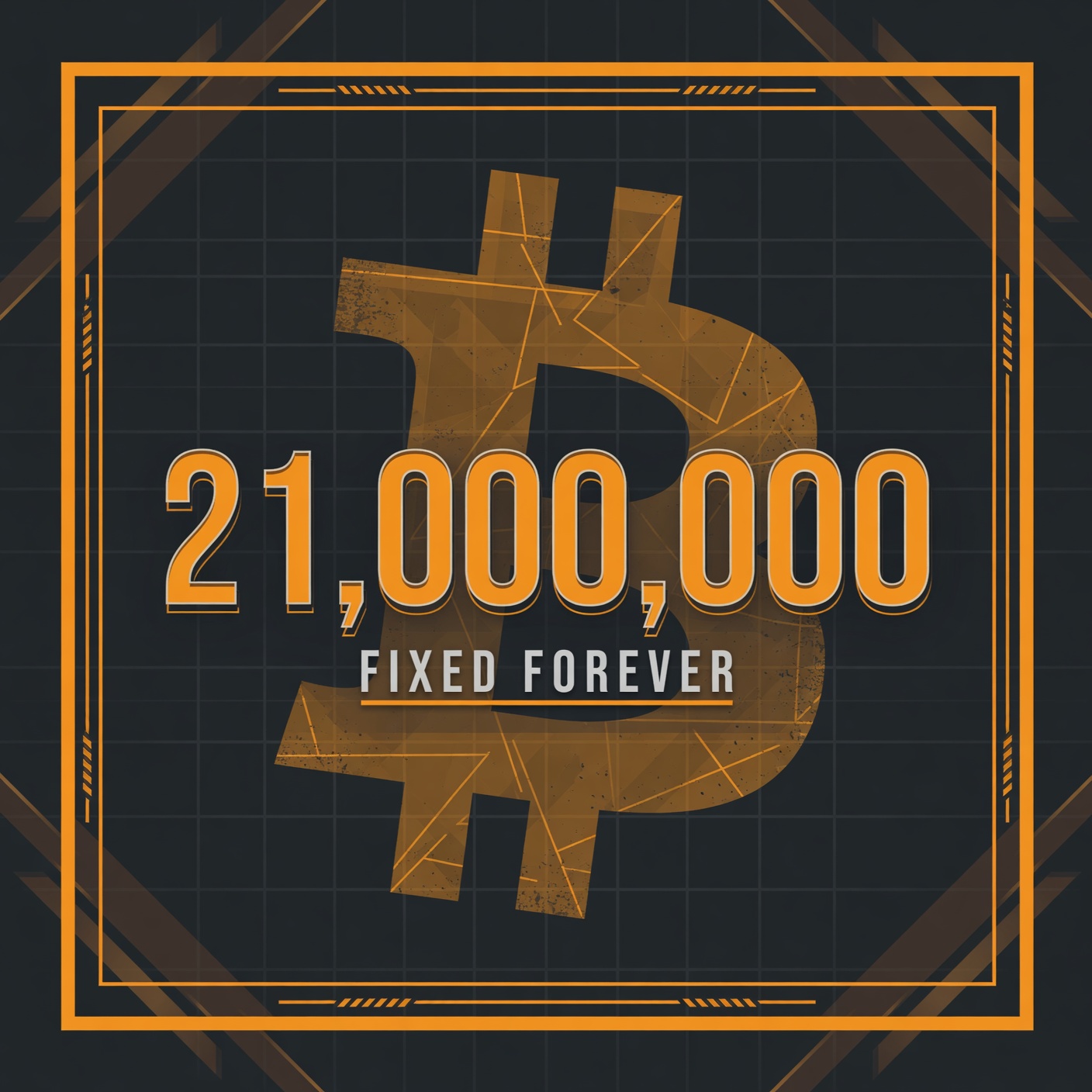
- Fixed supply — 21 million coins, forever. No committee, no government, no CEO can change this. It is enforced by code distributed across hundreds of thousands of nodes worldwide.
- No counterparty — Bitcoin held in self-custody has no issuer who can go bankrupt, freeze your account, or devalue your balance through money printing.
- Permissionless transfer — You can send value to anyone, anywhere, without permission from a bank, government, or payment processor.
- Censorship resistance — No transaction can be blocked at the protocol level by any authority.
None of those properties change when the price drops from $100,000 to $60,000. The code still enforces the supply cap. The network still processes transactions. Your keys still control your coins.
The Monetary Framework
Most Bitcoin holders who maintain conviction during downturns do so because they understand the monetary context — specifically, the problem Bitcoin is designed to solve.
The US dollar has lost approximately 96% of its purchasing power since the Federal Reserve was established in 1913. Since 2020 alone, the M2 money supply has expanded by roughly 40%. The dollar you hold today buys significantly less than the dollar you held in 2020.
This is not unique to the US. The Argentine peso, Turkish lira, Nigerian naira, Lebanese pound, and dozens of other currencies have experienced far more dramatic debasement in recent years. Inflation is not an accident — it is the designed output of fiat monetary systems that allow unlimited supply expansion.
Bitcoin is the first monetary asset with a verified, immutable supply cap enforced by decentralized consensus. Whether or not you believe it will succeed long-term, the problem it addresses is real and growing.
Stacking Sats: What DCA Actually Means
"Stacking sats" means accumulating satoshis — the smallest unit of Bitcoin, named after its pseudonymous creator Satoshi Nakamoto. One Bitcoin = 100,000,000 satoshis. Stacking sats is shorthand for dollar-cost averaging (DCA): buying a fixed dollar amount of Bitcoin at regular intervals, regardless of price.

Why DCA works for volatile assets:
- Removes the timing problem. No one reliably knows when Bitcoin will be at its lowest. Buying regularly means you automatically buy more sats when prices are low and fewer when prices are high — your average cost naturally trends toward a reasonable entry.
- Removes emotion from the equation. Scheduled purchases are mechanically executed. You don't have to feel good about the price to buy. This is particularly valuable during downturns when sentiment-based buyers stop buying or sell.
- Compounds in bear markets. When prices drop 50%, your fixed monthly allocation buys twice as many sats. Bear markets are where long-term stacks are built.
Practical DCA setup:
- Bitcoin journal and tracking notebook — Log purchases, dates, and amounts. This makes tax time manageable and gives you a clear view of your cost basis.
- Steel seed backup plate — If you're stacking regularly, your seed phrase custody becomes increasingly important. Steel backup makes your stack fire and flood resistant.
- Hardware wallet — Don't DCA onto an exchange indefinitely. Move to self-custody regularly — each transfer is a small exercise in the actual property rights that make Bitcoin worth holding.
The Four-Year Cycle and the Halvening
Bitcoin's supply issuance is cut in half approximately every four years. This event is called the halving (or "halvening" in community shorthand). At each halving, the block reward paid to miners is reduced by 50%:
| Halving | Year | Block Reward After |
|---|---|---|
| 1st | 2012 | 25 BTC |
| 2nd | 2016 | 12.5 BTC |
| 3rd | 2020 | 6.25 BTC |
| 4th | 2024 | 3.125 BTC |
| 5th | ~2028 | 1.5625 BTC |
The 2024 halving is now in the rearview mirror. New Bitcoin issuance has been cut from 6.25 BTC per block to 3.125. Historically, halvings have preceded significant bull markets — not because of superstition, but because of supply shock mechanics: demand continues growing while new supply entering the market is cut in half.
The cycle pattern: accumulation → halving → bull run → drawdown → accumulation. Drawdowns in this framework are not failures — they are the accumulation phase of the next cycle.
The next Bitcoin halving is estimated for 2028 based on the current block production rate. Block rewards will drop from 3.125 BTC to 1.5625 BTC. Historical patterns suggest the 2024–2028 cycle follows the same accumulation → halving → expansion structure as prior cycles — though past performance does not predict future results.
The Dollar Inflation Context
Understanding Bitcoin volatility in isolation, without understanding fiat currency debasement, gives an incomplete picture.
US M2 Money Supply — the broadest measure of dollars in circulation — grew from approximately $15.3 trillion in January 2020 to $21.7 trillion by April 2022: an increase of over 40% in two years. This was the largest peacetime monetary expansion in modern US history, associated with federal pandemic stimulus programs.
The consequence: the purchasing power of dollars held in savings declined. Goods cost more. Assets — real estate, equities, commodities — priced in dollars rose. The official Consumer Price Index peaked at over 9% annualized in mid-2022.
Globally, the situation is more acute. Fiat currency debasement is not a US-only story:
- The Argentine peso has lost over 90% of its value in the last five years. Inflation in 2023–2024 exceeded 200% annually.
- The Turkish lira declined from approximately 8 TRY/USD in 2020 to over 30 TRY/USD by 2024.
- The Nigerian naira saw the official exchange rate devalued by roughly 70% in 2023–2024 alone.
- The Lebanese pound collapsed to less than 1% of its 2019 value by 2023.
In each of these countries, Bitcoin adoption accelerated as the local currency deteriorated. This is not coincidence — it is Bitcoin being used for its designed purpose: a store of value that cannot be debased by local monetary authorities.
When you view Bitcoin's price drop in dollar terms, remember: the dollar itself is declining in purchasing power. A Bitcoin that drops from $100,000 to $60,000 in nominal terms may have dropped less — or not at all — when measured in purchasing power terms over a multi-year horizon.
Books for the Long-Term Holder
These books provide the frameworks for understanding Bitcoin's role as sound money, the monetary system it's positioned against, and the macro context for current market cycles.
Saifedean Ammous — The most complete argument for Bitcoin as sound money. Sound money history from gold through fiat, and why a fixed-supply asset class is the rational response to monetary debasement.
Amazon →Lyn Alden — The most data-rich argument for why modern monetary systems are structurally fragile. Essential context for understanding M2 expansion, reserve currency dynamics, and why fixed-supply assets matter.
Amazon →Jeff Booth — Technology produces deflation. Central banks fight deflation with inflation. The collision of these forces is the defining economic story of our era — and Bitcoin is the exit ramp.
Amazon →Nik Bhatia — The monetary system as a stack of layers: gold → Bretton Woods → Eurodollar → Bitcoin. The clearest framework for understanding where Bitcoin fits in monetary history.
Amazon →Neil Howe — Recurring generational cycles of institutional crisis and rebuilding. A macro lens for understanding the turbulence that surrounds Bitcoin's emergence as a monetary alternative.
Amazon →Ray Dalio — Reserve currency cycles, debt dynamics, and the rise and fall of empires. The big-picture framework for understanding dollar hegemony and why alternatives emerge.
Amazon →The Simple Summary
When Bitcoin drops hard, three things are true:
- The properties haven't changed. 21 million supply cap. Self-custody. Permissionless transfer. Censorship resistance. These are still true at $60,000, $40,000, or $20,000.
- The problem hasn't gone away. Fiat currencies are still being printed. The dollar is still losing purchasing power. The need for a fixed-supply, bearer-instrument monetary asset is, if anything, more acute when inflation is elevated.
- Every prior cycle recovered. Not guaranteed to repeat. But the structure — growing adoption, shrinking new supply, institutional accumulation during bear markets — has held across multiple cycles.
The test of conviction is not whether you can hold Bitcoin when it's going up. It's whether you understand it well enough to hold it — or stack more — when it's going down.
Contains Amazon affiliate links — we earn commissions on qualifying purchases at no extra cost to you. Not affiliated with Donald Trump, any campaign, or any government office. Full disclosure →